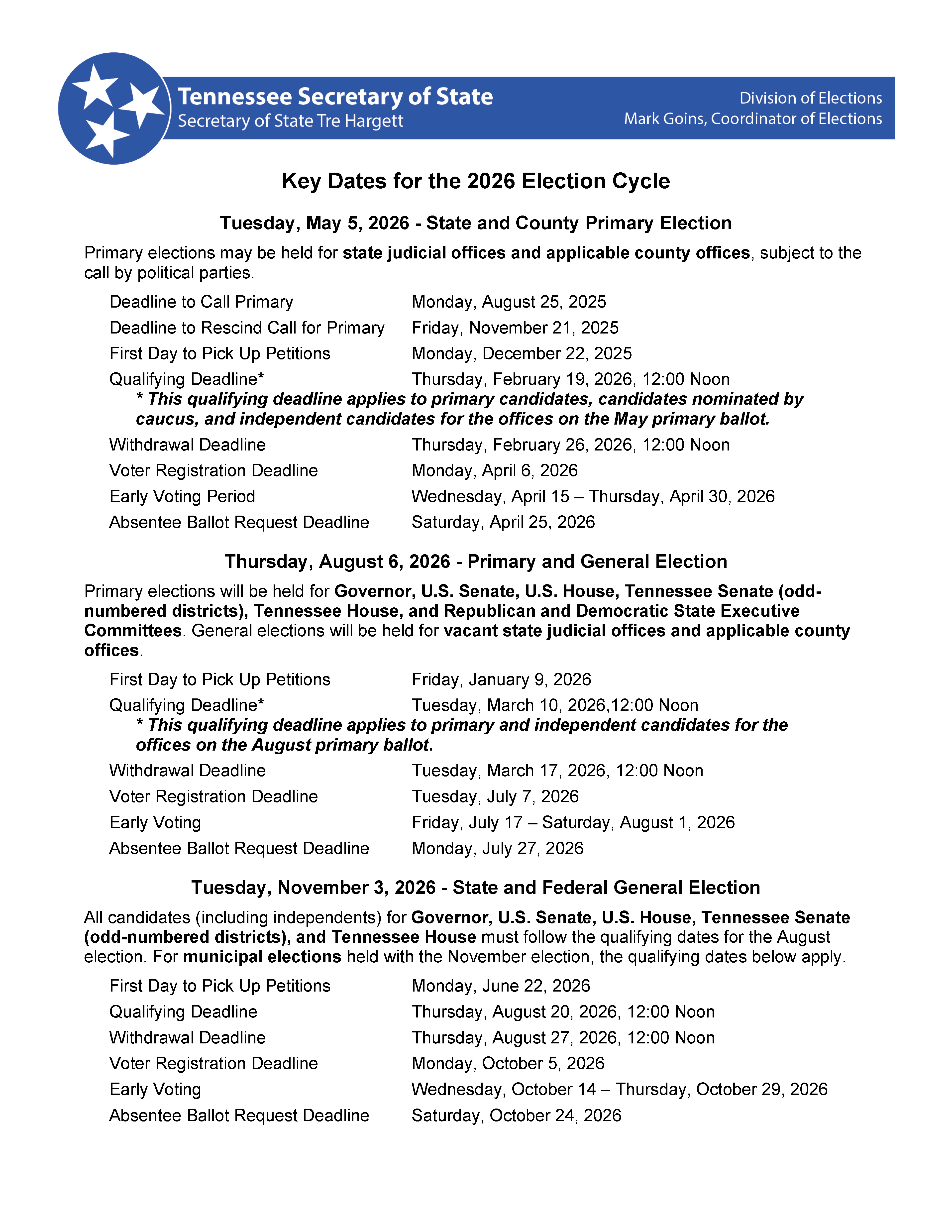
Key Dates for Upcoming 2026 Elections
For more information, go to https://sos.tn.gov/elections
Tennessee District Lookup, https://tn-cot.maps.arcgis.com/apps/InformationLookup/index.html?appid=a45bf122d3984cabb920ea396c4c6d0a
Sewanee Council Resolution Endorses the Jackson Law
by Leslie Lytle, Messenger Staff Writer
At the Jan. 26 meeting, the Sewanee Community Council unanimously passed a resolution endorsing the Jackson Law, a Tennessee rule assigning decisions about landfills to the local governing body. The Council also reviewed changes to the Dog Control Policy and heard an update on the University apartments.
Sewanee resident Kiki Beavers explained “the Jackson Law gives counties and cities the right to make local decisions about landfill development in their district and within one mile of their borders.” If the local governing body adopts the Jackson Law and decides not to allow a landfill, the Tennessee Department of Environment and Conservation cannot grant the landfill a permit. However, to adopt the Jackson Law, a municipality must be incorporated. “Unincorporated communities like Sewanee don’t have a legislative body with the power to adopt the Jackson Law and instead must work with their county commissioners to advocate for the county government to adopt the law,” Beavers said. The Sewanee Council considers the 37375 area code to be the boundaries of Sewanee and that area lies in both Franklin and Marion counties. Neither Franklin or Marion County have adopted the Jackson Law.
Statewide, 20 cities and 50 counties have passed the Jackson Law. “The places that don’t have Jackson Law protection are the ones that tend to be the first ones looked at when it comes to new landfills,” said Adam Hughes, east Tennessee organizer with Statewide Organizing for Community eMpowerment (SOCM). “We do need landfills, but to have a local governing body be able to say this is a place that it’s appropriate and this is a place that it is inappropriate is a power that is really important for all local governing bodies to have.” The South Cumberland Plateau is particularly vulnerable as a potential landfill site. “Prime places for putting landfills is in spent quarries, and we have multiple spent quarries,” said Lucy Keeble with United to Protect the Plateau. Area resident and SOCM representative Shari Lydy pointed to a recent effort in Murfreesboro to expand a municipal landfill to take out of state waste from all over the southeast. “The Jackson Law gives each local government, whether it’s a municipality or a county, the decision-making power, the right to accept or reject. There’s no downside,” Keeble insisted. In urging the Sewanee Council to pass a resolution endorsing the Jackson Law, Beavers said, “It’s a good conversation starter to engage our county commissions to start talking about this.”
Taking up the long-discussed dog policy issue, Provost Scott Wilson said, “Since the last meeting we’ve finished the dog policy that was in draft form and posted it to the University website.” To view the policy, see “Policies and Forms” on the “Leases and Community Relations” page. Wilson highlighted significant changes. The revised policy stipulates the police “will” enforce, rather than “may” enforce certain aspects of the policy. The revision also takes out language telling people harassed or attacked by a dog to contact the owner. The revised policy “takes the onus off the person who is dealing with a dog who is attacking them or is a nuisance,” Wilson stressed. The policy goes on to note there are financial and criminal penalties according to state law and gives links to the relevant Tennessee code.
The University apartment project is “officially underway,” said David Shipps, Vice President for Economic Development and Community Relations. Some land clearing and logging have been done and will continue in March with the official groundbreaking set for April. Shipps anticipates the 48 apartments would be ready for occupancy by late summer or early fall 2027.
The council elected Evelyn Patton to serve as the council representative on the agenda committee. Council member Laura Willis’s term on the committee expired in December.
‘Share the Love’ at Frame Gallery’s 8th Anniversary Arty Party
Join Frame Gallery Gifts and Art for a special anniversary celebration featuring hands-on art activities and live art demonstrations with local artists Randa Wells and Connie Keetle in Sewanee, on Saturday, Feb. 7, 2026, from 10 a.m. to noon.
Themed “Share the Love,” Frame Gallery’s eighth Anniversary Arty Party is a free event designed for all ages. Art supplies, party favors, and refreshments will be provided for guests and party participants.
During the celebration, make a Valentine or two with artist Randa Wells using her collage and cardmaking techniques — just in time for Valentine’s Day. Fellow artist and Frame Gallery’s own Connie Keetle will share her fascinating, unique painting process, using acrylic paints and walnut ink that she makes by hand. Both artists will have their original art, prints, cards, and Keetle’s walnut ink available for purchase on the day of the event.
Guests will also have opportunities to sign up for upcoming workshops and art projects at Frame Gallery’s new Community Table initiative with these artists, as well as Carole Foret and Linda Kerlin, among others.
“Since opening our doors in 2018, Frame Gallery has been honored to not only frame this community’s treasured pieces but also to celebrate local and regional artists, support fair-trade artisans, and host a wide variety of art, workshops, and events,” says Frame Gallery owner Harriet Runkle.
“I want to thank the artists, customers, collectors, teachers, students, and staff for supporting Frame Gallery for the past eight years—we truly couldn’t do this without you,” continues Runkle. “We want to share our love and gratitude with everyone in the community on this fun day, celebrating this milestone by creating art.”
Runkle recommends following Frame Gallery on Facebook or Instagram to stay up-to-date on the eighth Anniversary Arty Party activities, or visit <www.framegals.com/events> to learn more.
Square Dance at the Littell-Partin Center
Please join us for another lively square dance at the Littell-Partin Center in Tracy City on Friday, Feb. 6. Doors open at 4:30 p.m., and the dancing is from 5-7 p.m. There will be live music from local fiddler Bob Townsend and his band, The Cumberland Mountain Music Makers. The dances will be led by caller Earle Eames.
From 4:30-5 p.m. we are inviting the public to bring an instrument for an informal old-time jam. All instruments and musicians of every level are welcome.
There will be light snacks sponsored by the Junior Appalachain Musicians.
There will be a suggested donation at the door. Your support makes these dances possible.
Cumberland Community Dance is a part of, and receives support from, the Grundy Area Arts Council. We have a great slate of Spring dances planned, so if you’d like to keep up-to-date please sign up for our newsletter here <https://www.grundyarea.art/community-dance> and follow us on instagram by searching Cumberland Community Dance.
Nominations Open for the SCA Board
The Sewanee Civic Association invites nominations for open positions on the 2026-27 Board of Directors. Experience working in fundraising and for nonprofits is a plus, but any adult who resides in the area and shares concerns of the community is welcome.
Nominations are due by Monday, Feb. 16, 2026. The slate will be presented at the March 2, 2026 membership meeting. Voting will occur at the annual membership meeting on May 4. For more information, email at <sewaneecommunitychest@gmail.com>.
Monteagle Zoning: a Walkable, Vibrant, Affordable Downtown
by Leslie Lytle, Messenger Staff Writer
“The key to a vibrant downtown is enough houses and enough rooftops,” said Monteagle Alderman Nate Wilson introducing the discussion on “rethinking” C-1 commercial zoning ordinances regulating development on Main Street and the neighboring residential area. Monteagle received a Lyndhurst Foundation grant to use zoning as a tool to spur downtown development. For the past six months, a committee composed of city officials and residents met with consultants from Inc Codes, an Atlanta based firm specializing in zoning reform to encourage infill development in small to medium size communities. Distinct from C-2 and C-3 highway commercial zoning, Monteagle’s downtown corridor from the Assembly to Monteagle Elementary School is currently zoned C-1. Inc Codes recommendations, if adopted, will be incorporated in the town’s ordinance. “What is zoned C-1 is not changing, but what you can do there is,” observed Elizabeth Williams, Inc Codes architect and city planner.
Inc Codes, a name derived from “incremental codes,” stresses the importance of infill. “Right now the lowest residential density is close to Main Street. We’re trying to flip that,” Williams said. Infill would facilitate commercial growth and help remedy Monteagle’s housing shortage. The goal is a vibrant, walkable downtown corridor, a 10-20 minute half-mile walk, accomplished by small lot platting. Each lot with a business means tax revenue, explained Inc Codes Eric Kronberg who calls himself a “zoning whisperer.” Equally important, small lots mean lower purchase and building costs for developers. Inc Codes recommends no minimum lot size, a maximum lot width and depth to encourage smaller lots, a maximum 8,000 square feet building footprint, and a minimum 650 square feet footprint.
The proposed downtown district extends several blocks north and south of Main Street, but Kronberg noted the boundaries could expand. “Zoning should be a living, breathing thing,” he insisted. On Main Street, instead of a required front setback from the property line, Inc Codes proposes a “supplemental zone” for streetscape, with rules about the distance from curbs, sidewalks, and street side parking. Building on the front of lots is encouraged with parking in the rear, and the front of buildings should face the street.
A two-block segment facing the north side of Main Street and three-block segment facing the south side would be designated as “Primary Main Street” and would not allow residences on the ground floor at the front of the lot. Residences at the rear of a lot or on the second floor would be allowed, but Kronberg pointed out second floor residential construction was costly. Zero lot line building would be allowed, but Kronberg again cited the expense as prohibitive. As is the case now, the maximum building height would be three stories or 40 feet. Both new commercial and residential construction would have rules governing fenestration, i.e., how much of the front facade needed to be windows.
Constraints confronting Monteagle include water and sewer availability and Main Street being a state highway. Wilson expects a public meeting in the near future to address Monteagle’s water and sewer needs. Tennessee Department of Transportation rules and plans impact Main Street planning and development. Citing one problem, Kronberg said Main Street was not a good place for bike lanes and was dangerous for cyclists, whereas streetside parking would be far more beneficial. “You need to work on TDO,” Kronberg suggested.
Summing up goals, Williams said, “The purpose and intent is to encourage a walkable, vibrant Main Street serving adjacent neighborhoods. Affordability is really important and cultivating a sense of place, building on existing assets. Affordability is about people being able to build densely and to build small, so we’re allowing smaller lots and smaller units. We want to make it easier and more desirable to develop in the downtown area instead of just on the edges and to have a clear code that is easy to use with a streamlined permitting process.”
SUD: Commissioner Election, Year-End Finances
by Leslie Lytle, Messenger Staff Writer
With voting closing at the end of the business day, the Sewanee Utility District Board of Commissioners met to tally votes on the evening of Jan. 20, with nearly 70 ballots cast in one of the most highly contested elections in recent history. During regular business SUD manager Ben Beavers reviewed year-end finances for 2025, citing net income 51 percent over budget.
Five candidates vied for two seats on the SUD Board of Commissioners. At the December meeting the board set a slate of three candidates who had expressed a willingness to serve when the call for candidates went out in October: Ronnie Hoosier, Phil White, and Donnie McBee. McBee sought re-election. Two other would-be candidates submitted petitions signed by at least ten candidates before the Dec. 30 deadline: Amanda Bailey and Isabella Love. Each customer, defined as a residence or business having a tap, had two votes, although several customers only voted for one candidate. Amanda Bailey led the field with 40 votes, followed by Donnie McBee with 28 votes. Commissioners will be sworn in at the February meeting.
Reviewing the highlight of year-end finances, Beavers said about one-third of the over-budget revenue came from tap fees and water and sewer service development charges for new connections. “You never know how many meters you’re going to sell,” Beavers observed. Another revenue perk came from almost $80,000 in interest income, 32 percent over the budgeted amount. Expenses were right on target, within 0.2 percent of the budgeted amount.
The board will meet next on Feb. 24, the fourth Tuesday, rather than the third Tuesday, the regular meeting date.
Saving an Island Surrounded by a Park
by Leslie Lytle, Messenger Staff Writer
“Inholdings and edge holdings in the state parks are not at all uncommon,” said Friends of the Parks Executive Director Ned Murray. “All of these parks are typically multiple acquisitions over time. Savage Gulf was around 20 acquisitions over 20 years.” Murray explained an inholding owner may want to continue to use the land, perhaps to hunt there, or believes the land may have value one day, or does not trust the state; other times multiple names on a deed create complications. Park officials were aware of a small inholding at Grundy Lakes Park in Tracy City, slightly less than an acre within the park’s 162 acres. For a number of years, though, no one gave the heretic tract much thought.
That changed when a man who claimed he purchased the property confronted a park ranger as he was locking the gate for the evening at Grundy Lakes. According to George Shinn, manager of Fiery Gizzard State Park which includes Grundy Lakes, the alleged purchaser insisted, “I don’t want anybody on my property. I’m gonna need keys. I intend to build a pavilion.’”
Panic ensued. “That property doesn’t need to be in private hands,” Shinn said. “This cannot happen. That will ruin our whole experience for visitors and the historic value.” Significantly, the small tract includes the site of the former Lone Rock Stockade which from 1883-1896 housed convict laborers leased from the state for the lucrative Tracy City coal mining and coke oven operation. In 2019 University of the South archeologist Camile Westmont undertook excavating the Lone Rock Stockade site, opening the door to a little-known chapter on Tracy City’s past.
Grundy Lakes is part of the newly formed Fiery Gizzard State Park officially christened in October of 2025, state park holdings formerly grouped under the name South Cumberland State Park. But Grundy Lakes origin story long proceeds the rebranding. Created in 1978, South Cumberland State Park included Grundy Lakes Park, earlier known as Tracy Lakes. In 1935, the Tennessee Consolidate Coal Company donated 154 acres in Tracy City to the state, the former site of the massive coal mining and coke oven operation. Tasked with reclaiming the land, the Civil Conservation Corp created the lakes, planted trees and foliage, and constructed recreational facilities.
In 2011 Tracy City resident Abrey Hale purchased an acre of land within the Grundy Lakes Park from Sam Creighton, a Coalmont store owner. Creighton acquired the property in a delinquent tax sale. After Hale had the property surveyed, he contacted the park service. The park official Hale spoke with encouraged him to get back in touch if he ever decided to sell the property.
Administrative hurdles can make land acquisition a lengthy and burdensome process for the state, observed Ralph Knoll, a land acquisition consultant to the nonprofit Tennessee State Parks Conservancy. Hale was in no hurry to sell the property and Tennessee State Parks had no urgent need to purchase the small one-acre Grundy Lakes inholding until a Washington D.C. realtor contacted Hale wanting to buy the land. “They could have messed things up there, put up rental homes. It’s beautiful property,” Hale said. Anxious about selling the property to the Washington D.C. buyer, conversation ensued between Hale and the park service about a different path forward. Hale confirmed the property had not actually sold yet, but he was selling it.
“They [the park service] were very interested,” Hale said. “I’d rather work with you, I told them.”
The park service reached out to the Friends of the Parks and the Tennessee State Parks Conservancy about acquiring the land and transferring ownership to Tennessee State Parks. For NGOs (non-government organizations) to take the lead in parks acquiring private land is common practice. “The nonprofit world can act quicker and the process is less complicated,” Knoll said.
The price offered by the Washington D.C. realtor set the purchase price, according to Hale. “The state is limited to not paying more than the appraised value for property,” Murray commented. This prevents sellers from demanding excessively high prices. In the case of the Hale property, though, the price was in keeping with the appraisal. The partnership between the Conservancy and the Friends led to the Dec. 16 purchase of the Hale property, with the two NGOs sharing the cost 50:50. In February, Shinn will give a presentation to the state land’s acquisitions committee to explain why the state needs to own the land and urge them to buy it from the Friends and Conservancy. “The Friends group is awesome,” Shinn said. “They go into these deals knowing they may not recoup any money.”
“The land will be preserved for all time where it needs to be,” Hale stressed. But the question remains, why was there an acre of privately owned land within the tract gifted to the state by the Tennessee Consolidate Coal Company?
The likely answer: in 1896 the state of Tennessee ended the practice if convict leasing.
In the wave of rebellions at Tennessee coal mines in the late 1800s protesting convict laborers taking miners’ jobs, six stockades were burned in two years, including the Lone Rock Stockade. The Tracy City miners put the convicts on a train and sent them back to the penitentiary. But at many other mines, the convicts were set free. Historical archaeologist Westmont argues the $25 bounty offered for escapees proved the system’s downfall. The Tennessee Coal, Iron, and Railroad Company (TCIR), owner of the Tennessee coal mines, refused to pay the $25 bounty and rather than being stuck with the bag, in1896 the state stopped leasing out convicts, the first state in the nation to do so.
Up until then, two-thirds of the laborers at the Tracy City mines and coke ovens were convicts leased from the state of Tennessee. The cost per day of each convict was less than half the cost per day of each free miner. Without convict laborers, the lucrative mining operation became far less lucrative. TCIR shifted operations from Tennessee to Alabama where they could still use convict labor.
In 1900, with no need of a place to house convicts, TCIR deeded the stockade and stockade property to Gabe Hunter, but surface rights only, not mineral rights. In 1904, TCRI closed its Tracy City office. The newly formed Tennessee Consolidated Coal Company operated the Tracy City mines until 1935 when TCC donated the property to the state. A history of mortgage default and delinquent property taxes followed the acre of privately owned land within the mining company land TCC gave to the state, but that acre of land remained in private hands until the Dec. 16, 2025, purchase from Aubrey Hale.
Hale owns another small tract near the Fiery Gizzard trailhead, with conversation underway about possible acquisition of the land by an NGO which would in turn transfer the property to Tennessee State Parks.
What is the lesson in this story? “We need to be more proactive in conservation,” Murray insisted. “Friends of the Parks is proud to partner with the State Parks Conservancy to protect this critical site in perpetuity. We are grateful to the Hales for their vision and willingness to help us protect it.”
Note: In addition to those mentioned above, special thanks to Gayle VanHooser, Grundy County Register of Deeds, for researching land ownership for the stockade tract. If you have knowledge about how Gabe Hunter used the property, please contact Leslie Lytle at <sllytle@benlomand.net>.
Franklin County Schools’ Challenges: Virtual Academy, Vouchers
by Leslie Lytle, Messenger Staff Writer
“Just a little over a year ago we realized we were losing students to homeschool programs,” said Rachel Shields, Secondary Supervisor who oversees the Virtual Academy. “We wanted to meet them in the middle and provide an opportunity for them to keep them in the district and not lose them to other programs.” At the Jan. 12 Franklin County School Board meeting, Shields provided an overview of the virtual school program. The board also heard an update about concerns prompted by the state’s new Education Freedom Scholarships, which provide tuition supplements for students attending private school far exceeding the per-student allocation to public schools.
Shields capped enrollment in the Virtual Academy at 30, with a goal of 15 students the first year. She phoned over 100 parents urging them to enroll their children in addition to sending letters and hosting orientation nights. The Academy provides instruction for grades 6-8.
Allison Dietz, Sewanee Elementary School Principal, serves in the dual role of principal at the Academy. “We started in August with 10 students,” Shields said. “I was very excited to have 10. Seven of those were students we regained to the district.”
“Starting an online program seemed easy,” Shields said, “But you’re starting a new school, It has its own set of challenges when you don’t have the students sitting in the classroom to do morale things with and parents dropping their kids off making them easy to contact.” Shields acknowledged, “Two of the seven went back to their homeschool program, but the others we kept in the district [although attending] brick-and-mortar schools. We’ll continue the next school year with middle grades and hope to increase the enrolment. Our goal is to transition into the high school grade level.”
“What I appreciate,” said Director of Schools Cary Holman, “is the parents quickly realized students were held to a very high standard and how serious we are about education. If virtual school is what it takes for them to realize how serious we are about education, that’s what we’ll keep doing.”
With district funding directly linked to student enrollment, other new challenges follow from the state’s Education Freedom Scholarship program. Board member Sarah Marhevsky stressed the inequity in private school receiving the full-amount of the state’s $7,295 per pupil allocation while public schools only receive a percentage of that amount. “For our county it’s roughly 70 percent,” Marhevsky said. “We’re getting $5,106 per student, and the county has to kick in the remaining $2,188.”
For the 2025-2026 school year, the state capped scholarship awards at $20,000 with $10,000 designated for low-income students. Citing the eligibility table, with a family of four earning $173,160 qualifying as low-income, Marhevsky observed, “Interesting choices there.” The program cost the state $144 million the first year. The original proposal called for increasing the number of scholarship vouchers to 25,000 for the 2026-2027 school year, but Speaker of the House Cameron Sexton has proposed doubling the number of vouchers issued to 40,000.
Touching on another concern, Marhevsky said the Tennessee School Board Association is urging the General Assembly to allocate full funding for special education preschool students. “We passed a resolution on this. It [special education preschool] is mostly supported by the district, but it’s also required by law,” Marhevsky insisted
The board recently completed a self-evaluation, weighing performance against nine standards. With the highest possible score of 4, the board’s overall composite score was 3.25. “There was some good constructive criticism,” said Board Chair CleiJo Walker. The evaluation can be viewed on the meeting agenda for the January meeting at Franklin County Schools TN - Meeting Information.
The board will meet on Feb. 16 next month, rather than the regular meeting date of the second Monday.
Monteagle CDBG Grant Options, Ups and Downs
by Leslie Lytle, Messenger Staff Writer
Community Development Block Grants (CDBG) can provide up to $1 million in funding for counties and municipalities to undertake a wide array of projects ranging from playgrounds to fire halls to wastewater treatment plants. At a Jan. 8 public hearing at Monteagle City Hall, Southeast Tennessee Development’s Stacie Willoughby presented an overview of the options available to Monteagle, the caveats, and what might enhance Monteagle’s chances of being among the fortunate grant recipients. Willoughby serves as director of the Project Administration Department which facilitates the grant application process and makes sure grant recipients stay in compliance. She calls herself a “professional problem solver.”
The U.S. Department of Housing and Urban Development awards money for CDBGs to the states, and the states administer the grantee selection and oversight process. Tennessee received $26.6 million from HUD for 2026. A grantee can only have one open grant at a time. Monteagle received the full $1 million in 2023 for fire department equipment, skidders, and two trucks.
“We were very excited about that,” Willoughby said. “We’re closing out that grant, so Monteagle is eligible to apply again in 2026.” The deadline is March 20.
Three of the six grant categories provide funding for water or sewer related projects: water system rehabilitation, sewer system rehabilitation, and water line extension. The other three categories provide funds for fire department and EMA services, such as the grant Tracy City received for a firehall in 2024 (Public Health and Safety); improvements to roads, stormwater mitigation, and construction of public buildings such as libraries or community centers (Community Infrastructure); and rehabilitation of public buildings and downtown revitalization projects such as playgrounds (Community Revitalization). Willoughby pointed out “beautification” projects did not qualify for funding.
Integral to the scoring process and HUD objectives, to qualify for a CDBG an awardee must be able to prove 51 percent of the population who benefits from the project have low to moderate incomes. Monteagle Alderman Dean Lay asked if that would disqualify Monteagle from receiving a grant for sewer system rehabilitation since the primary beneficiaries would be commercial businesses such as restaurants and motels wanting to connect to the sewer system. Willoughby explained, sewer rehabilitation “would be considered a non-direct benefit since if Monteagle is doing well it will effect everybody in the community.” Resident Martha Ann Pilcher observed, “Motels mean jobs and taxes. Sales tax revenue is Monteagle’s only income.”
Lay also asked if serving areas outside the city limits would disqualify Monteagle from applying for a sewer rehabilitation CDBG. Willoughby dismissed the concern — “The city owns the sewer system.”
“Water and sewer rehabilitation projects usually score well, especially if you have a system that struggled in the past,” Willoughby said. “All over Tennessee we have aging infrastructure and growth that can’t keep up.” Willoughby acknowledged Monteagle would be competing against its neighbors for grant awards.
Alderman Grant Fletcher asked if Monteagle could combine several smaller projects from different categories. “You can only apply in one area,” Willoughby said. Citing the costly project underway of mitigating inflow and infiltration of stormwater into the sanitary sewer, Fletcher asked if an applicant could request funding for part of a project. “If it’s one $2.5 million project, we can submit that as the budget with CBDG covering part of that and look at your capital fund for the rest or stacking grants,” Willoughby said. “We stack grants all the time, but it is risky. You may get one grant, but you may not get another.” She also cautioned funding from all the grants sources might not come in at the same time, preventing a project from moving forward.
In addition, since CDBGs require a 15 percent matching contribution from the recipient, applicants must pass a resolution stating they can provide the match. A $1 million award with a 15 percent match of $150,000 would bring the total budget to $1,150,000 so the match would be $172,500. Citing another financial consideration, Willoughby said the project budget needed to include engineering and architectural expenses.
Looking to the timeline, Willoughby stressed if Monteagle decided to apply, once they decided on a project and notified her, procuring professional services such as an engineer or architect typically took up to three weeks, limiting the time she would have left to prepare a cost estimate and application before the March 20 deadline. Tennessee usually announced grant awardees in November or December. The grant contract process took another two months, Willoughby said. Together with other requirements, these factors could push the onset of construction to May. Further stymieing progress, every step of a project from environmental impact assessment to design specs to bid awarding required state approval, Willoughby noted.
“The first step is the public hearing,” Willougby said. “The next step is deciding if you want to apply and what for.”
Monteagle Mayor Greg Maloof thanked Willoughby and praised her for always being available and responsive in his interactions with SETD. Maloof anticipates holding a community meeting in the near future.
Monteagle: New Site Plan for Underway Building
by Leslie Lytle, Messenger Staff Writer
“The [revised site plan] showing the way we originally approved it, is not how it’s built” said Planning Commissioner Katie Trahan at the Jan. 6 Monteagle Planning Commission meeting objecting to the revised site plan for the already under construction Monteagle Market on West Main. “This is not acceptable,” Trahan insisted. Commissioner Alec Mosley concurred, “What’s the point in having a site plan when it’s built differently.”
Trahan pointed out the tanks were in a different location from what was shown on the site plan and the gas pumps were at an angle, rather than in a straight line as depicted. “This could affect traffic and landscaping issues,” Trahan said. She observed the contractors started excavation for the tanks before Thanksgiving and the site plan could have been updated to reflect the change. “We should have something accurate to look at,” Trahan stressed.
The one change on the revised site plan showed two parking spaces moved to the right of the entrance, with all parking in a line. Engineer Liz Rodriquez said the Tennessee Department of Transportation (TDOT) agreed to approve relocating the parking spaces if the agency received a letter from the planning commission authorizing the change.
On the advice of town planner Jonathan Rush, the commission rejected the revised site plan and voted to require a new site plan accurately depicting what was built and what would be built and prohibiting further changes without the commission’s authorization.
Taking up another site plan, the commission tabled approval of the proposed TownePlace Suites project. Engineer Christian Sawyer read from an email exchange with Monteagle engineer Travis Wilson in which the contractor agreed to assume any additional costs resulting from replacing the I-24 bridge, a TDOT project. “I would feel better if the site plan had a note [documenting the agreement],” Mosley said. Also at issue was the location of water and sewer lines. Similar to the Monteagle Market project, TDOT wanted approval from Monteagle before rendering a decision. Sawyer said the contractors had modified water and sewer line location in keeping with Wilson’s recommendations. The commission wanted direct confirmation from Wilson before granting approval. A final unresolved point was the business’s sign, still under design. “It has been submitted as public record there is a sign,” Rush said. “It shouldn’t be separated from the site plan.”
Revisiting the long disputed Petro truck stop project, resident Billie Best brought several considerations to the commission’s attention. Best said recently RBT, the Petro contractor, had attempted to pour footers. Best noted the RBT contractors argued they did not begin the project because of pending litigation. The argument was grounds for the project being grandfathered in and exempted from the new Monteagle stormwater ordinance. “There is still pending litigation,” Best said.
Best also cited discrepancy in the RBT contractor’s claim that the Monteagle Truck and Tire property would ultimately be deeded to the RBT project. “That property has never been deeded to RBT as far as I know,” Best observed. The site plan approval was conditional upon having “a means of egress onto Forsite Avenue,” Best said. “Without the means of egress [via the Monteagle Truck and Tire property}, they have no highway entrance permit.”
Best recommended, going forward, the commission eliminate “conditional site plan approval.”
“We will take that under advisement,” said Commission President Richard Black. According to Best, residents neighboring the Petro project are now represented by an attorney acting pro bono. “That development for that piece of property is bad for the town,” Best said. “It is bad for our air, it is bad for our water, it is bad for our traffic.”
Easter Semester Convocation to Feature Installation of the Dean of the College
The University’s Easter Semester Convocation will be at 4:30 p.m. on Friday, Jan. 16, in All Saint’s Chapel. The ceremony will feature the installation of Jennifer Cooley as dean of the College. New members will be inducted into the Order of the Gown, and, in accordance with a tradition established by Vice-Chancellor Rob Pearigen, the teaching and scholarship of the faculty will also be recognized and honored with a convocation address delivered by a member of the University faculty. This year’s remarks will be given by Professor and Chair of the Politics Department Mila Dragojević. A livestream is available here <https://new.sewanee.edu/parents-families/convocation-live-stream/>.
Savage Gulf State Park Expanded by 670 Ecologically Significant Acres
In the fall of 2024, TennGreen Land Conservancy, The Nature Conservancy in Tennessee, and The Conservation Fund successfully acquired 670 acres of ecologically significant, forested land adjacent to Savage Gulf State Park in Grundy County. This collaborative conservation achievement has now taken its final step: the land has been officially transferred to the State of Tennessee, where it will be permanently managed as part of Savage Gulf State Park.
We are deeply grateful to the following partners and supporters whose visionary funding made this project possible: the Open Space Institute, the Heritage Conservation Trust Fund, the Lyndhurst Foundation, Mary Lynn Dobson, Carolyn & Jack Long, and the Friends of South Cumberland State Parks.
“This project is a powerful example of what we can achieve through conservation partnerships. It builds on the legacy of our very first land protection effort in Tennessee, within what is now Savage Gulf State Park, and continues our commitment to safeguarding ecologically rich landscapes and expanding one of the Southeast’s most scenic public lands,” said Laurel Creech, Tennessee State Director for The Nature Conservancy.
The newly protected 670 acres rest within the Middle Cumberland Plateau Conservation Opportunity Area, a region identified in the Tennessee State Wildlife Action Plan as having exceptional habitat value.
The property also contains more than one mile of streams which flow directly into the Collins State Scenic River. The portion of the river within Savage Gulf State Park is designated a Class II Pastoral River Area, a legal status given to free-flowing, unpolluted waterways where agricultural and recreational uses harmoniously coexist with public enjoyment and ecological protection.
“We are pleased to work with TennGreen Land Conservancy, The Nature Conservancy, and The Conservation Fund on a successful project which is focused on important sensitive lands and waters in Tennessee. The protection of these lands adjacent to the Savage Gulf State Park will benefit Tennesseans for decades while promoting biodiversity, recreation, and watershed protection,” lauded Wayne Anthony, Timberland Investment Resources’ Senior Investment Forester.
“Savage Gulf is yet another feather in the cap of Tennessee’s world-class state park system,” Zachary Lesch-Huie, Tennessee state director for The Conservation Fund, added. “This new park safeguards wildlife habitat and an unparalleled river ecosystem for the benefit of folks across the Volunteer state, and I’m proud of the role The Conservation Fund played in bringing it to life.”
Numerous rare species have been documented on or near the property, including the wood lily (Lilium philadelphicum) and the eastern slender glass lizard (Ophisaurus attenuatus longicaudus).
Additionally, the endangered white fringeless orchid (Platanthera integrilabia) and yellow crested orchid (Platanthera cristata) have been documented on the tract. Notably, Savage Gulf State Park is home to one of the largest remaining populations of white fringeless orchid. By securing this property, we are ensuring that these species — and many others — can continue to thrive in the wild, uninterrupted by development or fragmentation.
Friends of South Cumberland State Parks is also proud to have been a collaborator in this “Tangible expression of our mission, ‘To protect, improve, and expand the state parks of the South Cumberland Plateau, and to educate and inspire others to join in this work,” added Ned Murray, Executive Director of Friends of South Cumberland State Parks. “We are grateful to TennGreen Land Conservancy, The Nature Conservancy in Tennessee, and The Conservation Fund for their leadership.”
Located in Grundy and Sequatchie counties, Savage Gulf became a Tennessee State Park in September 2022 after separating from South Cumberland State Park to allow for more concise management. This world-class park features some of Tennessee’s most scenic wilderness areas, including the nearly 19,000-acre Savage Gulf State Natural Area alongside the Great Stone Door area.
“The Open Space Institute is proud to help expand Savage Gulf State Park by 670 acres, ensuring that this ecologically rich landscape remains protected for generations to come,” said Joel Houser, OSI’s Director of Capital Grants. “This project reflects OSI’s commitment to climate resilience and connectivity — two critical factors for safeguarding wildlife and water resources in the face of a changing climate.”
By incorporating this property into Tennessee’s world-class park system, “We are investing in long-term ecological health and creating opportunities for people to experience and enjoy these remarkable lands,” Houser continued.
This expansion of Savage Gulf State Park reaffirms the power of partnership in conserving Tennessee’s natural legacy. With this addition, more habitat is protected, more watersheds are secured, and more opportunities for outdoor recreation are made possible. Together, we continue to build a resilient, connected landscape — one that will enrich the lives of Tennesseans today and far into the future.
Initial Stages for the University Apartment Construction Process to Begin
Following an Oct. 22 announcement to the community, Sewanee Village Ventures (SVV) will begin initial stages of the construction process for 48 new apartments for employees beginning Thursday, January 8th. This first phase will consist of harvesting timber as part of a larger project managed by the Office of Environmental Stewardship and Sustainability (OESS). Following, site clearing will take place in preparation for construction scheduled to begin in May 2026. Illustrations, floorplans, and a site plan for the two three-story buildings can be found online here.
Expanding employee housing options is a key priority within the University’s strategic plan. Adding apartments in the Village significantly advances the University’s ability to provide attractive and affordable housing in Sewanee, while creating an additional pathway for many employees to live on the Domain. Importantly, this initiative will help reverse the decades-long trend of faculty and staff living farther from campus, and foster greater interaction and connection with our students.
A groundbreaking will be scheduled for April 2026, and construction will take place between May 2026 and the summer of 2027 with the goal of welcoming employee residents shortly thereafter.